

The concept of sandwich construction dates back to the 19th century; however, it wasn’t widely adopted at the time. The technique truly gained momentum in the 20th century, when the aerospace industry required materials with an optimum strength-to-weight ratio.
Composite Sandwich Panels Explained
A structural sandwich is a specialised form of laminated composite, comprising a combination of materials bonded together. These utilise the properties of each separate component to the structural advantage of the whole assembly.
A lightweight and relatively thick core separates two thin, stiff, and strong faces. The faces are either adhesively bonded or thermally welded to the core, enabling effective load transfer between the components.
Today, a wide variety of facing materials, cores, and adhesives allows for the creation of composite panels tailored to meet a broad range of requirements across various fields of application.
While a composite sandwich panel typically consists of two face sheets and a core, it may also include additional intermediate layers and reinforcements.
A composite panel’s performance and durability depend on the proper harmonisation of its constituent parts and the panel manufacturing process itself. This configuration corresponds to the load distribution typical of an I-beam, in that when bending, the flanges carry in-plane compression and tension loads (as do the face sheets), and the web carries shear loads (as does the core).
Like a traditional I-beam, the structure gains more proportional stiffness when the flanges (face sheets) are spaced further apart. A thicker core achieves the same effect but provides an overall low density, leading to a high stiffness-to-weight ratio.
In a sandwich, the faces take the place of the flanges, and the core takes the place of the web. The difference is that the core of a sandwich is of a different material from the faces, and it is spread out as a continuous support for the faces rather than concentrated in a narrow web.
The faces will act together to form an efficient stress couple counteracting the external bending movement. The core resists shear and stabilises the faces against buckling or wrinkling. The bond between the faces and the core must be strong enough to withstand the shear and tensile stresses set up between them. As such, the adhesive that bonds the faces to the core is of critical importance.
Designing and Developing
When developing composite panel specifications, it is crucial to identify the mechanical stresses that are likely to occur during the panel’s operation. While the outer layers of such panels absorb compressive and tensile forces, it is the core layer that must perform adequately in terms of shear and dynamic forces.
Shear forces impact the core material when a panel is subjected to bending. Dynamic forces, including those created by wind, vibration, and torsional stress, affect panels during operation.
The high compressive strength of the core material has a stabilising effect on a composite component, reducing the risk of outer layers buckling when subjected to compression. One should assess whether the loads will induce bending forces once the panels are integrated into the final application.
It is crucial to examine any shear forces that may impact the core and any specific loads anticipated in the facings, as they could lead to buckling and cracking. The selection of components for the sandwich panel involves considering the application, its performance requirements, and cost factors.
Materials and Sizing
Designing sandwich structures involves both material selection and sizing considerations.
The array of material choices is extensive, and since the introduction of fibre composites, the variety of face materials has expanded to an almost infinite number of options, each with unique properties. Furthermore, the number of available cores has dramatically increased in recent years with the advent of more cellular plastics.
While the vast selection of materials may seem like added complexity, it is actually one of the main advantages of sandwich constructions. This is because the most suitable materials for a specific application can be utilised, and some limitations can be addressed through geometrical sizing. For instance, certain reinforced plastics lack the high stiffness associated with metals, but by increasing the core thickness, it is still possible to achieve adequate rigidity.
Materials are often selected based on criteria that extend beyond pure mechanics, considering factors such as environmental resistance, surface finish, cost, and wear resistance.
Unlike traditional materials such as wood and metal, composite sandwich panels can be engineered to improve performance while also reducing weight. These panels are specifically designed to meet defined performance criteria, including:
- Adjusting core thickness to affect stiffness
- Selecting suitable core materials to control overall weight
- Modifying fibre content to optimise the stiffness-to-weight ratio
- Choosing the right resin types to enhance structural strength
This exceptional adaptability allows for customised performance tailored to a range of end-use applications.
The advantages provided by this design include:
- High stiffness and strength-to-weight ratios
- Integration of functions such as thermal and acoustic insulation
- High energy absorption capability
Composite Materials
The way sandwich structures enhance a system’s flexural rigidity without significantly increasing weight has made this concept even more beneficial since the introduction of composite materials.
These materials typically offer at least equivalent, if not greater, strengths compared to metals like aluminium or steel. However, their moduli are often much lower, resulting in poor stiffness performance. By employing sandwich composites, this issue can be easily addressed.
A typical sandwich consists of an upper and lower layer, with a significantly thicker core in between. Additional intermediate layers can be incorporated into a panel to enhance its performance. These layers can also protect the foam core from high temperatures and extreme temperature fluctuations. Each part of a sandwich serves a specific function, which is described below.
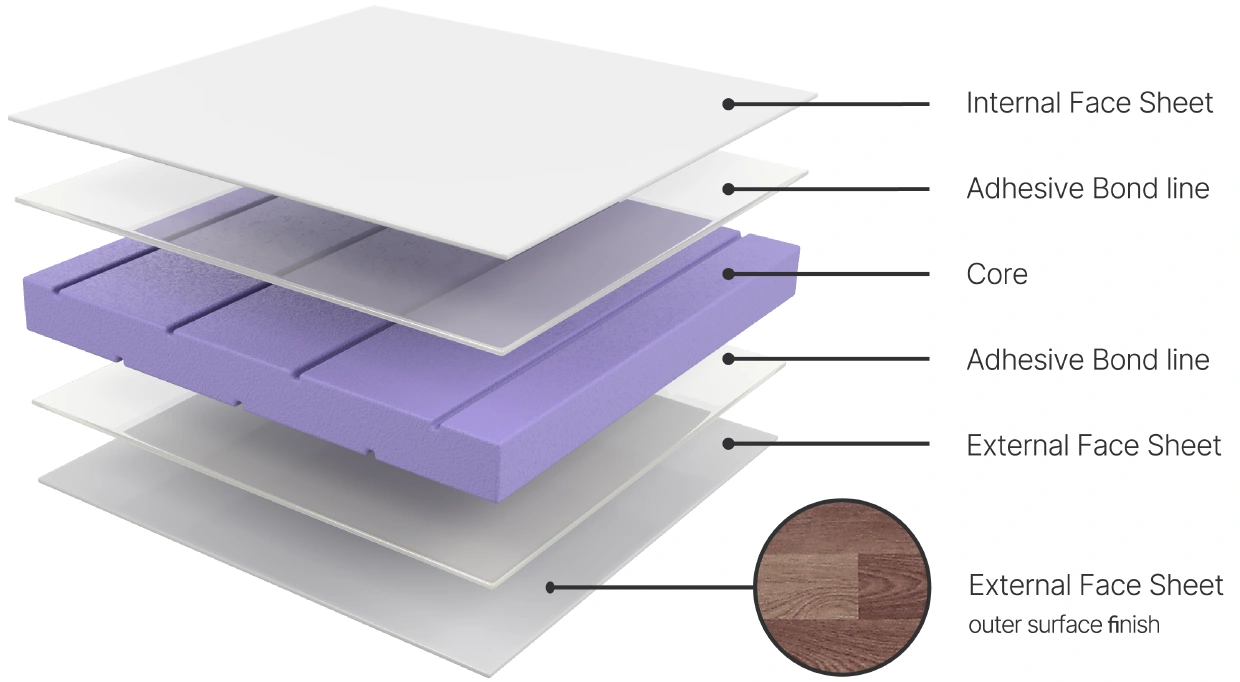
Faces
The faces carry the tensile and compressive stresses in the sandwich. Conventional materials, such as fibreglass, are often used as a face material. Fibreglass can be tailored to fulfil a range of demands, such as anisotropic mechanical properties, design flexibility, and an excellent surface finish.
Core
The core’s function is to support the thin skins, ensuring they do not buckle (deform) inward or outward while keeping them in relative position to one another.
The core must possess several important characteristics to achieve this. It needs to be stiff enough to maintain a constant distance between the faces. It must also be sufficiently rigid in shear to prevent the faces from sliding over each other. The shear rigidity compels the faces to cooperate effectively. If the core is weak in shear, the faces will not work together, leading to a loss of stiffness in the sandwich structure.
It is the sandwich structure as a whole that provides the positive effects. However, it is essential to note that the core must meet the most complex demands. Strength in various directions and low density are not the only properties required of the core. Often, there are specific requirements for buckling, thermal insulation, moisture absorption, and weight. The core can be constructed from a range of materials, such as extruded polystyrene (XPS) and polyethylene terephthalate (PET) foams.
Adhesive (Bonding Layer)
To ensure that the faces and the core work together effectively, the adhesive between the face sheets and the core must efficiently transfer shear forces between them. The adhesive needs to withstand both shear and tensile stresses.
Specifying the requirements for the bondlines can be quite challenging. A simple guideline is that the adhesive should be capable of handling the same shear stress as the core.
Face Sheets
The commonly used face materials can be classified into two main categories: non-metallic and metallic materials.
The non-metallic group includes fibreglass and continuous fibre-reinforced thermoplastic laminates, while the metallic group consists of steel and aluminium. The most significant category of materials mentioned is non-metallic, which has greatly influenced the use of sandwich construction since its introduction. This is because most composites provide strength properties that are comparable to, or even surpass, those of metals, although their stiffness is often considerably lower.
Thus, to achieve high rigidity, composites are frequently layered with a lightweight core. One notable characteristic of composites is their anisotropic behaviour; that is, they display different properties in various directions. This initial complexity is often seen as a challenge by engineers, but it is, in fact, an advantage as it creates the opportunity to customise properties based on the applied loads.
For instance, a sufficient amount of fibres can be oriented in a specific direction to support the load in that direction, while a different amount can be utilised in another direction. Therefore, not only is the material composition stressed to its ultimate limits, but the component itself can be used more efficiently.
Thermoset Resin Systems
Thermoset resin systems require a curing process to chemically cross-link the polymer.
The resin starts as a liquid and solidifies once cured, resulting in a permanently rigid structure. Due to the cross-linking of the polymer, thermoset resins exhibit high-temperature stability, creep resistance, and excellent mechanical performance. Additionally, these resins require various chemicals for processing, including curing agents, hardeners, and inhibitors.
Furthermore, additives can be integrated into the system to enhance toughness, UV resistance, or flame retardancy.
Thermoplastic Resin Systems
Unlike thermosets, thermoplastic resins lack molecular cross-linking, which allows them to be melted and reshaped multiple times after their initial formation.
These resins are recyclable and provide excellent impact resistance, toughness, and effective noise and vibration damping. Additives can be incorporated into thermoplastic resins to improve toughness, UV resistance, or flame retardancy.
GRP Facings
Fibre-reinforced plastic facings are considerably lighter and more elastic than metal ones. The cost benefits of glass-fibre-reinforced plastics (GRP) result in their near-exclusive use in the commercial and recreational vehicle sectors. Glass-fibre-reinforced plastics consist of glass fibres embedded in a plastic matrix. This combination retains the advantages of both materials: the plastic offers high flexibility and impact strength with low weight and good insulation properties, while the glass fibres provide rigidity and strength. Generally, a higher proportion of glass leads to greater tensile strength.
When a thermosetting plastic matrix is used, the compound cannot be remelted once it has cured. Fibre manufacturers produce the glass component as continuous fibres with diameters ranging from 10 to 20 μm. These filaments are employed to create tissues, mats, and fabrics for the GRP facings.
Tissues comprise short glass fibre pieces that cover and enhance the appearance of mats and fabrics, often combined with gelcoat applications. Meanwhile, gelcoat improves UV light and weathering resistance.
The embedded plastic matrix consists of a liquid resin that wets the glass fibres and secures them after curing. The resin in the gelcoat layers is based on isophthalic acid, which offers high breaking strength and greater chemical resistance compared to standard laminating resins based on orthophthalic acid. Additives in resins can enhance the composite material’s resistance to UV radiation or achieve specific colour designs.
CFRTP Facings
CFRTP facings utilise a continuous resin transfer moulding process where resin is injected to saturate continuous glass fibres as they are drawn through a die. The facesheets are customised to specific fibre volumes and orientations to meet the required performance standards. Thermoplastic tapes are made in a continuous process that pulls fibres through a die to saturate them with resin, forming them into single-ply, continuous sheets.
Laminate facesheets for panels are created by stacking various layers of unidirectional composite tape in off-axis, 0-degree and 90-degree orientations based on the property requirements of the panel. These composite laminates provide the necessary mechanical performance for the panel’s construction.
The properties of primary interest for the face sheets are as follows:
- High stiffness provides excellent flexural rigidity
- High tensile and compressive strength
- Impact resistance
- Surface finish
- Environmental resistance (chemical, UV, heat, etc.)
- Wear resistance
Core Materials
The core material provides shear resistance for sandwich panel construction. Panels can be made from a variety of core materials, including foam, honeycomb, and plywood, with the selection based on the end-use applications and requirements.
Foam Cores
Foam cores are the preferred choice when low weight, high thermal insulation, low moisture absorption, and excellent mechanical properties are required for sandwich panels. Compared to timber-based cores, plastic foams have a lower material density. Depending on the gross density and cell structure of the foam, the core can absorb significant forces of compression, tension, and shear.
Closed-cell foams exhibit low moisture absorption, while the gas trapped inside the cells contributes to low thermal conductivity. Core materials include rigid boards made from extruded polystyrene (XPS) and polyethylene terephthalate (PET) foams.
XPS Foam
Rigid extruded polystyrene foam offers excellent strength values and a relatively low weight. The raw material is introduced into the extruder as granules and is melted and forced through as a viscous mass. The mixture is extruded through the machine’s nozzle, where the blowing agent causes the semi-fluid plastic to foam. This extrusion process yields a closed-cell structure with exceptional mechanical properties.
If intended for use in a sandwich panel, the rigid foam board is milled to meet the required thickness tolerance and grooved if necessary. Due to its high stability, rigid extruded polystyrene foam is commonly utilised in vehicle construction, particularly for wall and roof structures.
Thanks to its viscoelasticity, rigid extruded polystyrene foam can absorb high dynamic loads and various mechanical stresses. Additionally, it has low moisture absorption. Due to minimal water absorption through diffusion, long-term high insulating properties are maintained. As a result, extruded polystyrene is frequently used in structures for dry freight and refrigerated commercial vehicles, as well as recreational vehicles.
PET Foam
PET foam is manufactured from polyethylene terephthalate, resulting in a thermoplastic foam. PET is a truly sustainable solution that boasts excellent thermal resistance, fatigue behaviour, and compressive strength.
PET is fully recyclable and, more importantly, can be made from 100% recycled products. To maximise its mechanical properties, it is advantageous to orient the foam perpendicularly to the sheet. This is achieved by welding the sheets together and then cutting them to the desired thickness.
Used as a core material in composites, PET helps reduce the weight of road and rail vehicles by up to 50% compared to conventional metal components, thereby reducing fuel consumption and carbon emissions. Screw retention is a key additional benefit for all markets. PET meets the most relevant international fire and smoke regulations for rolling stock, as well as those applicable to the aviation market.
Basic Principles of Bonding
Bonding refers to the joining of two materials (which may be similar or dissimilar) using an adhesive layer, without causing structural changes in those materials. When bonding two substrates, it is essential for the adhesive layer to create a strong connection between them.
Physical principles
The physical principles behind the term ‘bonding’ are complex. The key terms are cohesion and adhesion.
The forces that produce the intrinsic stability of an adhesive are referred to as cohesion forces, while the forces that create an attraction between the adhesive and the substrate are termed adhesion forces.
The cohesion of an adhesive initially depends on interactions between the polar side chains of individual molecules (dipoles) and subsequently on smaller molecules joining to form polymers (very long, chain-like molecules) as the adhesive cures.
Depending on their composition, the polymers can also be linked to one another through cross-linking. In the extreme case, reactive adhesives form a solid, three-dimensional network.
Since an adhesive must wet the surface of the substrate, it must first be in a liquid state; only later will it gain mechanical stability through internal cross-linking and bonding with the substrate’s surface.
A simple test for a substrate is the water drop test: a few drops of water are applied to the surface to be bonded. If the water runs, the wetting properties are good; if it does not, the surface will be difficult to wet. Although this test does not provide precise conclusions about the adhesion properties of the surface, it serves as a starting point. Surface tension can be accurately determined using special test inks.
Adhesives for the Production and Assembly of Sandwich Panels
A distinction is made between physically setting and chemically curing adhesives.
In the first case, the polymer systems that produce cohesion already exist and are either dissolved (in solvents or, in the case of dispersions, in water) or melted to allow wetting of the surfaces to be bonded.
In contrast, chemical reactive systems, which account for a large proportion of sandwich panel construction, consist of monomers or pre-polymers (the precursors to polymers). The desired macromolecules, which cross-link with each other to provide internal stability (cohesion) for the adhesive, are formed through a chemical reaction.
For commercial and recreational vehicles, polyurethane adhesives dominate sandwich construction, which is created through the chemical reaction of isocyanates and polyols, as well as the physical bonding of reactive hot-melt adhesives. Chemically curing polyurethane adhesives can be either 1-component or 2-component systems (1C and 2C systems). Both are usually free of organic solvents and thus environmentally friendly.
1-Component Polyurethane Adhesives
1-component polyurethane systems consist of pre-polymers that include isocyanates. To cure, that is, to form internal bonds, they require moisture, which contributes the active hydrogen needed. The result is a cross-linked plastic that absorbs the mechanical stress acting on the adhesion. Wanning reduces the curing time.
1-component systems generally exhibit a more or less pronounced foam structure. On the one hand, this allows for smoothing out production tolerances in the components to be assembled (foaming); on the other hand, it also weakens the adhesive film.
1-component adhesives are typically easier to handle than 2-component systems, which require mixing of the reaction partners. However, with 1-component adhesives, humidity as a reaction partner (as much as 10% of the adhesive’s weight) must always be present.
If moisture is not available in the ambient air and the substrates are dry, the moisture must be supplied. This diminishes the advantage of easier handling, as insufficient or excessive water may result in spots where the adhesive fails, and excess water trapped behind impermeable facings can lead to a decline in long-term resistance.
2-Component Polyurethane Adhesives
2-component polyurethane systems comprise a polyol resin component and an isocyanate hardener. They offer greater stability than 1-component systems as they typically lack a foam structure.
There is also increased flexibility for adjusting the chemistry to suit processing technology and mechanical requirements. Low-viscosity 2-component systems with a slow reaction speed are utilised for the production of sandwich panels and more generally, in large-area structures with a load-bearing function. When applied in a paste-like consistency, they are ideal as an assembly adhesive for bonding structures, providing an extended open time and a short press time.
Reactive Polyurethane Hot-Melt Adhesives
A more recent development is the use of polyurethane hot-melt adhesives. When heated, they become liquid and wet the surfaces to be bonded; as they cool down, they bond with each other.
In many applications, it is advantageous for the process to be quick and for the bonds to release at temperatures above the fusion temperature. Like one-component polyurethane adhesives, reactive hot-melt adhesives contain polyurethane pre-stages. They are initially liquefied by heating to wet the surfaces that are to be bonded; the pre-polymers then react with moisture in the air, and the molecular cross-linking produces a duroplastic polymer that cannot be melted again.
A significant advantage of reactive hot-melts is that after cooling, they quickly achieve handling stability and, after complete chemical curing, are very temperature-stable. Application volumes of as little as 120 to 150 g/m² are required, sometimes even less. The low volume of adhesive necessitates careful surface preparation, as roughness and production tolerances are more difficult to compensate for with the thin film of adhesive. Reactive hot-melts demonstrate outstanding flexibility and elongation at rupture.
Structural Design
The specification of materials for sandwich panels requires careful consideration of performance parameters, technical formulae, and prior experience. Manufacturers of sandwich panel components can advise users on structural design questions to ensure optimal results are achieved.
Performance generally correlates directly with the panel’s weight. Improvements in performance can typically be achieved by using higher specification facesheets, thicker facesheets, higher specification cores, or thicker cores.
Mechanical Loads
Where the expected loads are known, the bending of a single sandwich panel, comprising two facings and a foam core, can be calculated relatively precisely based on the behaviour of a horizontal sandwich beam resting on two supports.
The key mechanical parameters of the foam core include its compression resistance and shear resistance. Compression forces affect the core as soon as a supported sandwich panel is subjected to a vertical load. If the maximum compression load of the foam core is surpassed, its cell structure collapses, resulting in the crushing of the sandwich panel.
Shear forces come into play whenever a sandwich panel is bent. Tensile forces affect the core material when, for instance, heavy loads are applied to a roof panel. If the maximum permissible force is exceeded, the panel may experience plastic deformation (and subsequently fail to return to its original shape) or even break.
All these force effects are simulated in the laboratory on sample pieces to determine the loading limits of individual components, as well as those of finished and bonded sandwich panels.
The compression resistance is evaluated by measuring the maximum compressive force the material can withstand before failure. The tensile (bonding) strength of a material indicates the maximum tensile load that the test sample can endure without breaking.
When the load acts parallel to the shearing surfaces, shear resistance is tested, meaning the shear stress needed to cause the test piece to fail. In fatigue tests, manufacturers also examine how their products perform over extended periods under constant load.
Rigid extruded polystyrene foam exhibits a very low degree of creep behaviour: even after 50 years of consistent loading at one-third of the permissible short-term load, it shows only a 2% compression.
In addition to mechanical loads, the constructor must consider thermal and other stresses that arise during use. When exposed to strong sunlight and high summer temperatures, the exterior of a dark-painted vehicle body becomes significantly hotter than the interior: with black facings, temperatures approaching or exceeding 90°C are not uncommon. If the materials used in a sandwich panel have differing thermal expansion rates, the panel may buckle.
A similar effect can occur with moisture, which may cause swelling in a plywood layer without affecting the foam core. Even in the absence of mechanical influences, bending forces arise from such environmental conditions. Testing and structural calculations conducted by test laboratories allow for these effects to be taken into account in the design of a sandwich panel.
Thermal Insulation
The insulating properties of a sandwich panel are crucial, especially in the design of refrigerated vehicles. The key performance parameter is thermal conductivity.
The thermal resistance R (in m²·K/W) of a material layer is calculated by dividing the layer’s thickness by its thermal conductivity. In a sandwich panel composed of three or more layers, the total thermal resistance is the sum of the thermal resistance values for each layer.
The thermal transfer coefficient, which assesses the insulating properties of a sandwich panel, includes the thermal resistance of the individual layers, as well as the thermal resistance at the internal and external surfaces (from the air to the internal surface, the internal heat transfer resistance a_internal, and from the external surface to the air—the external heat transfer resistance a_external).
The crucial parameter for thermal transfer is the thermal transmittance, k (in W/(m²·K)). Its reciprocal value is calculated as follows: The thermal transmittance of the completed sandwiched construction also relies on the thicknesses of the layers and the orientation of the sandwich panels within the surrounding construction, including the inevitable formation of thermal bridges. The foam core contributes significantly to thermal insulation; its insulating properties depend on various factors, including density, cell size and orientation, cell content, and board thickness. The long-term thermal insulation capacity of a foam core is also affected by moisture. Two tests are of importance:
- Water absorption during long-term immersion shows that closed-cell substances perform better
- Moisture uptake by diffusion provides particularly useful information if composite panels are intended for use in refrigerated vehicle construction
The permeability of a material to water vapour influences its insulating properties. The volume of water vapour that diffuses through a specific thickness of material over a defined time period and under specific temperature and moisture conditions is expressed in relation to the corresponding air permeability, described as a vapour diffusion resistance value μ (μ-value).
Rigid extruded polystyrene foam (XPS) offers particularly high resistance to vapour diffusion, which enables the prediction of the material’s long-term insulating properties.
Panel Loading Considerations
When designing a panel, it’s crucial to consider the forces that will act on the panel during use to optimise its performance. The three primary loads that typically impact panel applications are compression, tensile, and shear forces.
Compression
Compression loads are inward forces acting on the surfaces of the panels. Applications where panels may encounter compression loads include trailer or truck beds, flooring, and marine decking.
To optimise for compression, panels must be designed to minimise deformation or crushing under compressive loads while maintaining the lowest possible panel weight.
Tensile
Tensile loads are outward pulling forces that strain the adhesion between the core and face sheets of a panel. When panels experience bending loads, one face sheet is in compression while the opposing face sheet is in tension. Designing a panel to prevent delamination of the skins is essential when optimising for tensile load.
Shear
Displaced bending forces on a panel are termed shear load. Panels experience shear loading when installed across short loading spans or on uneven surfaces, such as vehicle ramps.
Considerations regarding the panel’s support during use must be taken into account when designing for shear loads. The facesheets must be configured to deflect adequately to prevent the core from shearing.
Panel Failure Modes
When designing and testing panels for specific application requirements, understanding when and how a panel fails is critical for optimising panel performance and minimising failures in end-use applications.
Facesheet compression failures appear as fractures in the facesheet material on the compression side of the panel. This often occurs when the load is concentrated rather than distributed across the panel.
Delamination occurs when, under bending loads, the facesheet material peels or pops away from the core substrate. This may indicate that the panel is either too stiff or thick to adequately yield to the bending load and support span, or that there is insufficient bond strength between the facesheet and core material.
Core shear typically happens when the panel deforms and flexes until the core material ultimately breaks or shears. Panels experience increased shear loading during impact events and when support spans are closely spaced. These failures can occur in isolation; however, panels more frequently exhibit compound failures, indicating a combination of factors that contribute to performance deficiencies.
Explore our Composite Sandwich Panel Materials
Each one of our products has been meticulously engineered to provide lightweight performance, superior durability, and exceptional thermal insulation. Utilised across vehicle manufacturing, construction, and industrial applications, our materials are distinguished by quality and performance.
Lightweight and durable, our Fibreglass (Glass Reinforced Plastic) offers exceptional corrosion and UV resistance, high impact strength, an aesthetic appearance, and versatility.
Sustainable and strong, PET foam delivers high compressive strength and thermal performance. An ideal alternative for automotive and construction panel core structures.
A state-of-the-art material incorporating continuous fibres with thermoplastic polymers, CFRTP offers an outstanding strength-to-weight ratio, superior impact resistance, and enhanced recyclability.
Lightweight and moisture-resistant with strong thermal insulation and excellent screw retention. Ideal for structural cores requiring stable and secure fixings.
Rigid and moisture-resistant, XPS provides excellent thermal insulation and long-term durability for lightweight structural applications.
Advanced bonding solutions for robust and enduring composite panels, offering exceptional durability and performance across a wide array of applications.