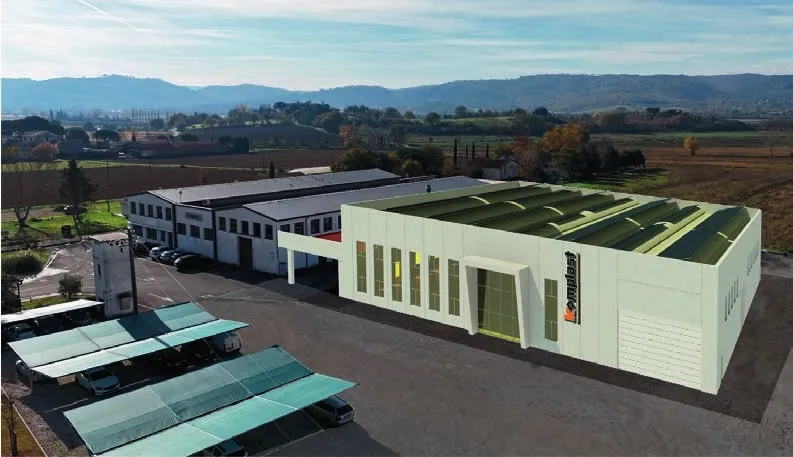

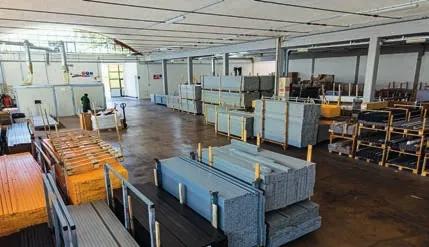
Komplast was founded in Italy in 2008 and is now a benchmark in the RV component industry. The company is growing fast. Construction of a third industrial shed is currently underway, and 21 extrusion lines will be installed to continue focusing on innovation and sustainability. Kombiplast structural wall and floor profiles made of PVC foam are light, strong, and versatile. The new, top-of-the-range Kimera rolling shutter systems were presented at the 2024 Düsseldorf Caravan Salon. Words Andrea Cattaneo
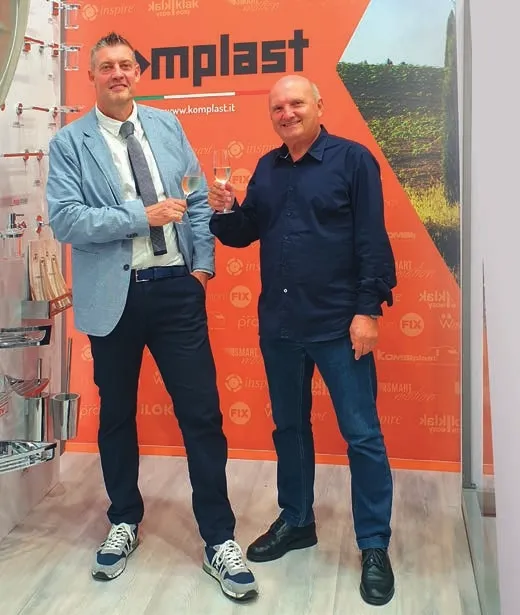
Founded in Lucignano near Arezzo, Italy, in 2008 by Francesco Lucaroni and Luca Rossi, Komplast is now one of the most dynamic players in the RV components industry. The company was born from the experience of the two founders in the plastic furniture industry and the focus soon turned to the RV world carrying over solutions originally thought for home furniture to vans and motorhomes. Today Komplast is expanding. A third facility, which will be dedicated primarily to the round-the-clock production of structural profiles, will soon join the two plants already in operation. This will increase the number of operating extrusion lines from 17 to over 21. The leap in size and production capability will further bolster the company’s leadership in the industry, with a strong focus on innovation, customization, and sustainability.
Kombiplast: intelligent, versatile, and sustainable profiles
From the beginning, Komplast believed that structural wood in sandwich panels could be replaced with PVC foam profiles, which are lighter, impervious to moisture, and more durable. The idea was a successful one. Komplast’s structural profiles are now the go-to choice for RV builders throughout Europe, Japan, Australia, and South Korea.
Kombiplast is a tradename and the expression of a production philosophy focused on technical innovation and environmental sustainability. Kombiplast profiles are density-controlled PVC foam components designed to replace wood battens in the construction of walls, floors, and roofs of recreational vehicles. The company is proud to state that its material was ranked among the top thirty innovative materials at the 2016 INOVYN Awards showcase. For over a decade, Komplast has developed the expertise to precisely manage material density, offering solutions ranging from lightweight interior frame structures to stronger load-bearing profiles. The real revolution is in the integrated recycling process. Today, Komplast recycles 100% of production waste, including scraps and profile grinding chips. The result is a re-granulated material (soon to earn “Plastic Second Life” certification) that is enriched with a newly created compound.
“This is the real hub around which all production pivots today”, said Francesco Lucaroni, owner and sales manager. “The chemical process was developed over the years through countless experiments to restore the initial characteristics of the material in terms of fluidity, stability, and expansive power. This virtuous circle allows almost infinite product regeneration without impacting on its fundamental properties”.
- Dimensional stability and durability
- Optimized lightness (about 450 kg/m³, lighter than wood)
- Excellent adhesiveness for bonding and coating
- Mechanical and screw resistance
Kombiplast profiles are also highly cus tomizable in length, section, and thermal curvature. The brushed surface improves adhesion, and they are compatible with decorative coatings and HPL papers. The range is completed by flat sheets of the same compound, from 15 to 30 mm thick, which are ideal for CNC machining, special shapes, inserts, and joints for furniture and custom components.
Komplast does not just recycle its own production waste. The company is actively working to offer recycling services to customers and third parties as well, in an increasingly concrete circular economy approach in the industrial sector. The Kombiplast system is the result of extensive experimentation on materials and extrusion die optimization. Today, it is a benchmark in wood replacement in the RV industry for components that are immune to moisture, durable, modular, and sustainable.